








Gifting has never been easier
Perfect if you're short on time or are unable to deliver your gift yourself. Enter your message and select when to send it.

Short answer: Work through it in this order. How many riders — one, two, or three-plus. Which style — flat deck (versatile, you lie down), wing (fastest, less drag), or sit-down couch style (easiest on the body, best for young and older riders). What cover — every tube we sell for two or more has an 840 denier nylon cover, and some add neoprene where your elbows and knees sit. Then match the rope to the tube, because an under-sized rope on a loaded tube can snap.
We carry over a hundred tube models, which is a lot to sort through. Reuben works through the whole category in the video below — sizes, the three styles, covers, ropes, tow points, inflation and storage.
Reuben on choosing and looking after a towable tube — 10 minutes 41 seconds.
Everything else follows from this. We do one person, two person and three-plus person tubes.
One thing that is the same across the range: every tube we sell for two riders or more has a heavy-duty 840 denier nylon cover. That is what lets a tube take everything you throw at it over a season.
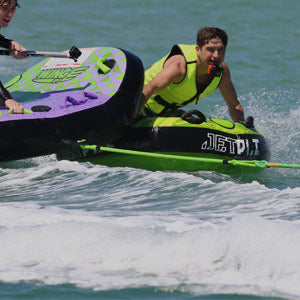
Big, durable and the most versatile of the three. Two to three-plus riders, or lie down with just one or two on board. The trade-off is that you are lying down holding yourself on, so they take a bit of arm strength over a long session.
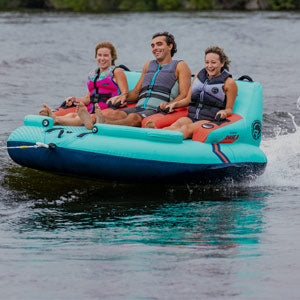
You sit down and the tube holds you in, so it is far easier on the body — the pick for younger riders and older riders who want to cruise and have a laugh without paying for it the next day.
Many have a reversible tow point. Tow it as a couch with your feet forward, or flip it and ride kneeling in a chariot position holding the backrest. That second position is a lot more of a ride, so as the kids grow you can get more out of the tube you already own rather than replacing it.
The fastest and the most fun. The turned-up wings on the outside cut drag so the tube skims across the surface quicker than a flat deck or a couch — while still giving you the same amount of surface area to lie on. Available in one, two and three-plus.
Driver, this one is on you. A wing tube accelerates hard when you put it into a whip. Keep the speed sensible and stay a good distance off the bank — the tube covers ground fast at the end of an arc.
The 840 denier nylon cover is about durability. Neoprene is about your skin. A soft-top neoprene deck stops the nylon rash and burn you can pick up on your elbows and knees over a full day of tubing.
Some tubes are neoprene across the whole top. Plenty of others put neoprene just where your elbows and knees land and keep the same 840 denier nylon everywhere else — heavy duty where it needs to be, comfortable where you are.
This is the most important part of the setup: it is the only thing connecting the boat to the riders. A rope that is too thin for a loaded tube can snap, so match the rope to how many people are on board.
If you are between two, buy the stronger one. An over-strength rope costs you a little extra weight and nothing else.
Worth it once you are on a three-person tube or bigger. The bungee section soaks up the energy when the rope comes tight at the end of a whip. That means a smoother ride for the riders, and less wear on the tow point of your boat or jet ski and on the tube's own tow point. We also sell the bungee section by itself so you can add it to a rope you already have.
Tow from the lowest point, as far back as you can get it. On a lot of boats that is the small cleat towards the transom.
There is a full walkthrough of every tow point in how to attach a tow rope to your boat or jet ski.
Use a volume air pump — a double-action hand pump or a 12-volt volume pump. Do not use a compressor: it can over-inflate and pop the tube.
A properly inflated tube is firm enough that you can stand on it without it depressing much around your feet. The trick on the bigger tubes: get it as tight as the volume pump will take it, then finish with a double-action hand pump to force the last bit in. A soft tube drags.
The single most common tube fault. Around nine times out of ten, when someone brings a tube back saying it is deflating, it is a cross-threaded valve — the thread is plastic and crosses easily, and it causes a slow leak. Pull the valve all the way out and thread it all the way back in before you assume there is a puncture.
Start there before anything else. We stock one, two and three-plus person tubes. Every tube we sell that seats two or more comes with a heavy-duty 840 denier nylon cover, so durability is not the thing separating them — size and style are.
A flat deck is the versatile all-rounder: big, durable, and you lie down on it. A wing style is the fastest — the turned-up wings cut drag while giving you the same area to lie on. A sit-down or couch style holds you in and is far easier on the body, which suits younger and older riders.
A sit-down or couch style. You are seated and held in by the tube rather than holding yourself on, so there is much less strain. Flat deck and wing tubes have you lying down, which takes a fair bit of arm strength over a long session.
It lets you tow a sit-down tube two ways: as a couch with your feet forward, or kneeling and facing forward holding onto the backrest. The kneeling or chariot position is more of a ride, so as the kids get older you can get more out of the same tube instead of replacing it.
It is a heavy-duty cover that stands up to being dragged, whipped and loaded all summer. Every tube we sell for two or more riders has one.
Neoprene on the deck stops the nylon rash and burn you can get on your elbows and knees over a long day. Some tubes are neoprene across the whole top; many have neoprene just at the elbows and knees with 840 denier nylon everywhere else.
Match the rope to how many people are on the tube. A rope that is too thin for an overloaded tube can snap, which is dangerous. We stock one-person, two to three person, and three to six-plus person ropes. If you are in any doubt, go up a size — an over-strength rope costs you nothing but a little weight.
On anything three-person and up, yes. The bungee section absorbs the energy when the rope comes tight in a whip. That is a smoother ride for the riders and less wear on both the boat's tow point and the tube's. We also sell the bungee section on its own to add to a rope you already own.
From the lowest point, as far back as you can — on a lot of boats that is the small cleat towards the transom. If your boat has no centre tow point, an outboard bridle solves it.
With an outboard bridle. It is a length of rope, from about 2.8 m up to 5 m for wider boats with bigger engines, with a loop at each end that goes to your cleats or rings. A swivel pulley runs along the rope so the pull stays centred instead of dragging to one side.
You can thread the rope through the tow point and back through itself, but you have to redo it every time. A jet ski quick connect stays attached to the ski, and your rope threads onto it in seconds.
Firm enough that you can stand on it without it depressing much around your feet. Use a volume air pump — a double-action hand pump or a 12-volt volume pump. Get it as tight as the volume pump will take it, then finish with a double-action hand pump to squeeze the last bit in.
We would not. A compressor can over-inflate and pop the tube. Volume air pumps are designed for the job.
Probably not. Cooler water shrinks the air inside and the tube looks like it is deflating. Put it in the water for two to three minutes before you tow, then top it up — that gives you the right pressure at the temperature it will actually be at.
Nine times out of ten it is a cross-threaded valve. The thread is plastic and crosses easily, which causes a slow leak. Pull the valve all the way out and thread it all the way back in so it seats properly.
Take the valve all the way out, get all the air out, and make sure the tube is completely dry before you fold it. Storing it damp causes mould in the cover, and water can work its way into the bladder — you want air in there, not water.
Over a hundred models is a lot to work through on a screen. Give us a call or come into the Brisbane store — tell us who is riding and what you tow with, and we will narrow it down fast.
Waterskiers World — Australia's dedicated towed water sports retailer, family-run for over 20 years from our Brisbane store and online. Get in touch.
Sign up for exclusive deals, latest product drops and more, plus get a first-order discount.
