








Gifting has never been easier
Perfect if you're short on time or are unable to deliver your gift yourself. Enter your message and select when to send it.

Short answer: Set the boat to about 10 mph on the smaller of your two wave settings. Float on your back with your feet shoulder width apart on the edge of the board closest to you, back foot towards the tail, and the board across your feet. As the boat takes up the rope, push your heels down so the board comes up on edge, pull your knees to your chest with your ankles as close to your backside as possible, and let the boat pull you out of the water. Stay in that low squat until the board planes, then stand up slowly. Once the wave is carrying you, pull yourself forward on the knots and drop the rope.
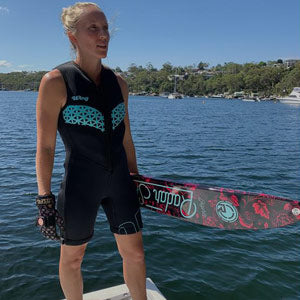
Wake surfing is one of the easier towed sports to learn — the boat speed is slow, the board is big and forgiving, and there is no binding to fight. Almost everyone who struggles is struggling with the same thing: the board will not stay under their feet. Reuben walks through the fix in the video below, and it comes down to how tightly you tuck up before the boat pulls.
Reuben runs through getting up on a wakesurf board — 3 minutes 24 seconds.
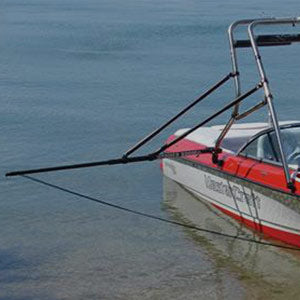
From the shop — boat type is not optional. Wake surfing must only be done behind an inboard-powered boat, where the propeller sits underneath the hull. Never behind an outboard or a stern drive. You ride a few metres off the back of the boat with no rope in your hands, and on those boats the propeller is exposed.
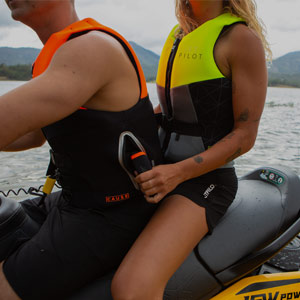
From the shop — life vests in Australia. A rated life vest is not just good practice here, it is a legal requirement for towed watersports, and the rules differ by state and by waterway. Our state-by-state life vest guide sets out what you need where you ride.
Two settings matter before anyone gets in the water.
The driver's job is slow, steady acceleration — not a hard pull. Keep the rider directly behind the boat as they come up.
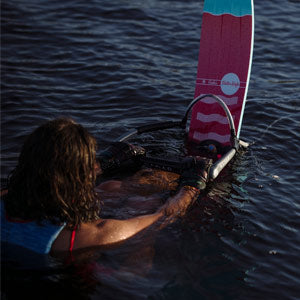
Slide in with the board and get your feet onto it — about shoulder width apart, pressed against the edge of the board that is closest to you, with your back foot towards the back of the board and sitting close to that edge. The board ends up across your feet, perpendicular to the boat.
Arms straight, knees bent. Let the rope go tight rather than pulling yourself towards the boat.
As the boat starts to move, press your heels down so the board flips up on edge and the face of it comes towards you.
This is the part most people get wrong. Bring your knees into your chest and get your ankles as close to your backside as possible. Tucked up like that, the board sits under you and the boat can pull you straight out of the water — let it do the work.
Hold the low squat while the boat pulls you up and the board starts to plane. Do not try to stand up too quickly — you will fall down. Straighten your legs gradually, and avoid leaning too far back or too far forward.
Once you are up and stable, use the knots to pull yourself in towards the front of the wave. When the wave is carrying you and the rope goes slack, drop it into the water.
Once the rope is gone, your feet do the throttle.
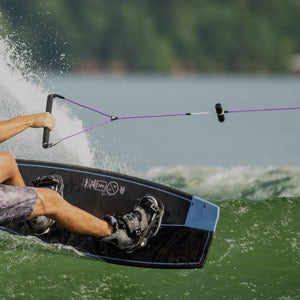
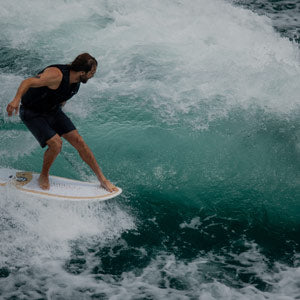
For your stance, point your front hip towards the opposite corner of the boat and keep your shoulders square with the wake. That closes your stance off a little, which points the board directly into the path of the wave.
About 10 mph. That is slow enough for the boat to push up a surfable wave and slow enough that you can climb onto the board without being dragged.
Feet about shoulder width apart, pressed against the edge of the board closest to you — the rail nearest your body — with your back foot towards the back of the board and close to that edge. From there the board sits across your feet, perpendicular to the boat.
Almost always because your feet are too far out in front of you. Pull your ankles in as close to your backside as you can and let your knees come to your chest. The tighter you are tucked, the easier the board comes up as the boat takes up the slack.
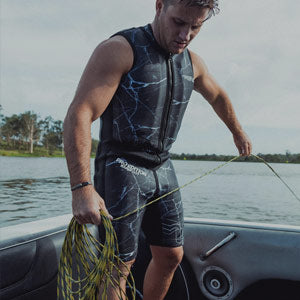
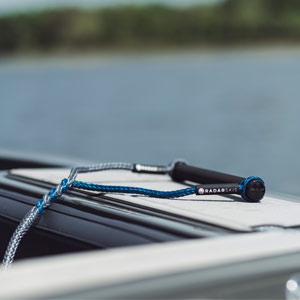
Around 25 feet, with knots along it. The knots let you pull yourself in towards the front of the wave once you are up and riding.
Yes. A surf rope is short, knotted and made to be dropped and picked up in the water. A ski or wakeboard rope is too long and has no knots to grip.
To speed up, shift your weight onto your toes and lean slightly forward. To slow down, move your weight back onto your back foot.
No. Wake surfing must only be done behind an inboard-powered boat, where the propeller sits under the hull. Never behind an outboard or a stern drive — you ride close to the back of the boat with no rope, and the propeller on those boats is exposed.
A correctly rated vest, worn any time you are being towed. Life vests are a legal requirement for towed watersports in Australia and the rules vary by state and by waterway. Our state-by-state guide sets out what is required where you ride.
Not sure what suits your boat and your weight? Talk to us — we ride this gear ourselves and we would rather point you at the right board than sell you the wrong one.
Waterskiers World — Australia's dedicated towed water sports retailer, family-run for over 20 years from our Brisbane store and online. Get in touch.
Sign up for exclusive deals, latest product drops and more, plus get a first-order discount.
