











Gifting has never been easier
Perfect if you're short on time or are unable to deliver your gift yourself. Enter your message and select when to send it.

Short answer: Measure around the widest part of your palm and around the back of your hand, then check that against the size guide on the product page of the glove you want. A correct fit has no material bunching across the palm when you hold a handle, your fingers right at the end of the glove, and the strap doing up securely. If the gloves are brand new and dry they will be hard to get on — precurved ones should be very hard to get on. That is not the wrong size, that is the design.
Most fit complaints we get on gloves are not sizing problems. They are a new pair of gloves behaving exactly the way a new pair of gloves is supposed to behave. Reuben runs through how to measure, what a correct fit actually feels like, and the one test worth doing before you go anywhere near the water.
Reuben on fitting a water ski glove — 2 minutes 27 seconds.
A good pair of gloves is worth having whether you are a casual skier or one of the top-end skiers ripping through the course. Get the right pair the first time and you save yourself torn calluses and blisters. You will also hold on longer in high-load situations — slalom and jumping in particular — with less forearm fatigue and your nails protected.
Run a tape around the widest part of your hand — normally through the centre of the palm — and around the back of the hand. That single measurement is what the size charts are built on.
Glove sizing is not standard across brands, so there is no universal chart. Every glove we sell has its own size guide on its own product page — use that one, for that glove. Depending on the model, sizes run anywhere from 3XS through to 2XL.
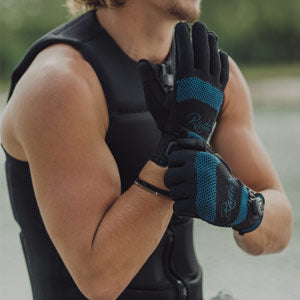
Put the glove on and hold something like a handle. There should be no material bunching across the palm, your fingers should sit right at the end of the glove, and the strap should do up securely.
Loop a handle over a bollard or have someone hold it, then grip it the way you would behind the boat. Under load is the only way to know: check for bunching against the handle, and check the glove feels close and secure the way you want it to.
Brand new and dry, gloves are a fight to get into. Precurved gloves should be very difficult. This is deliberate.
Most water ski gloves are built with neoprene on the back of the hand and Amara on the palm side. Both of those materials stretch with wear and stretch again once they are wet. A glove that slides on easily in the shop, dry, is a glove that will be loose and bunching on the handle by the third set.
From the shop — snug when dry is the target. Gloves move more once they are wet, so judge the fit dry and expect it to relax. If a glove feels comfortable and roomy dry, it is too big.
This is not in the video, but it is worth knowing before you buy, because the palm material is not just about durability — it is about what it is gripping.
If you are not sure what your handle is made of, our ropes and handles breakdown goes through the grip materials.
Because they should be. New gloves are difficult to get into when they are brand new and dry, and precurved gloves should be very difficult. They are built that way on purpose — they stretch with wear and once they are in the water.
Measure around the widest part of your palm, which is normally through the centre of the palm, and around the back of the hand. Compare that measurement against the size guide on the product page of the glove you are looking at.
Snug. No material bunching across the palm when you are holding a handle, fingers right at the end of the glove, and the strap doing up securely. It should feel snug when dry — gloves move more once they are wet.
Most gloves use neoprene on the back of the hand and Amara on the palm side. Both materials stretch with wear and in the water, which is why a new glove feels tighter than a broken-in one.
Not straight away. Fit complaints on gloves are more often a fitting-technique issue than a sizing issue, and a new precurved glove is meant to be hard to get on. Work through the fit checks above first. If you are still not getting the right fit after that, start an exchange through our returns form.
The precurve matches the shape your hand takes on the handle, so once the glove has stretched to your hand there is less material to bunch up in the palm. The trade-off is that they are the hardest gloves to get on when new and dry.
It helps. Kevlar palms grip best on natural rubber handles, which is what high-end slalom and jump handles use. On EVA and suede handles a less aggressive palm material works better. Match the glove to the handle you actually ski behind.
Yes — fewer blisters and torn calluses, less forearm fatigue, protection for your nails, and you hold on longer under high load. That matters most in slalom and jumping, where the loads are highest.
Between two sizes, or not sure which palm material suits your handle? Give us a call — we fit these in the shop every week.
Waterskiers World — Australia's dedicated towed water sports retailer, family-run for over 20 years from our Brisbane store and online. Get in touch.
Sign up for exclusive deals, latest product drops and more, plus get a first-order discount.
