








Gifting has never been easier
Perfect if you're short on time or are unable to deliver your gift yourself. Enter your message and select when to send it.

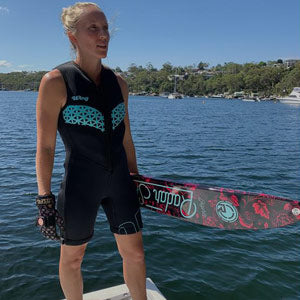
Towed watersports are about one rider, one rope and a lot of style. At the top level they split into two families. Three-event water skiing is the classic tournament discipline — slalom, tricks and jump — where skiers chase precise, measurable results, and can compete in any one event or all three for an overall title. Wake is the freestyle side — wakeboarding behind a boat, or at a cable park — judged on the difficulty and style of the tricks.
Australia has a strong scene across all of it, from local club days to the Moomba Masters in Melbourne, one of the biggest tournaments in the world. Here’s how each event works and how it’s scored — and how to get involved. Try the game under each event to get a feel for it.
The skier passes through an entry gate and then zig-zags around a series of six turn buoys, three on the right-side alternating with three on the left-side, before passing through the exit gate. It’s a test of precision and timing
How it’s scored
On a short, wide, fin-less trick ski, the skier performs as many different tricks as possible — surface spins, wake flips and step-overs — in two timed passes.
How it’s scored
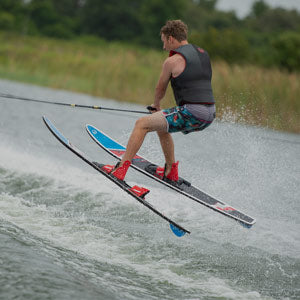
The spectacular one. The skier cuts hard at a fixed ramp and launches off it, flying as far as possible before landing and skiing away.
How it’s scored
Try all three ski events in the game below.
Skiers can specialise in one event or take on all three. Compete in slalom, trick and jump and you’re eligible for an overall ranking — your scores from each event are combined into a single overall result. Going for the overall is harder than specialising (you’re spread across three disciplines), but it’s the path to the all-round title.
Because the three events are scored in completely different units (buoys, points and metres), they’re normalised before being combined and then compared. The highest score by an overall competitor in an individual discipline is awarded 1000 points, and each other overall competitor receives a percentage of the 1000 points. The overall competitor with the highest aggregated score is the winner.
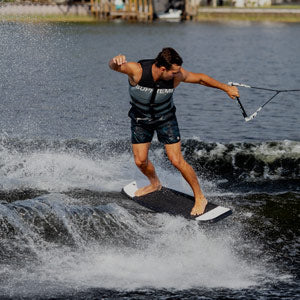
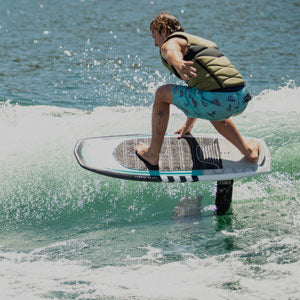
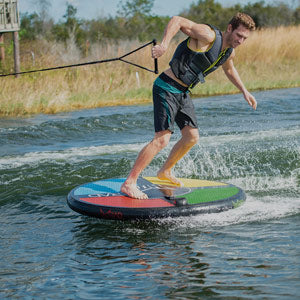
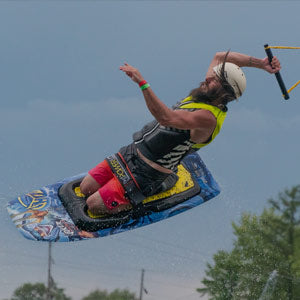
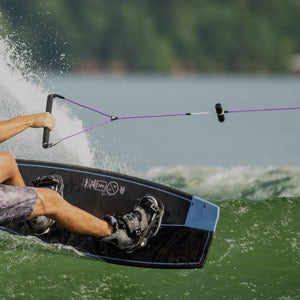
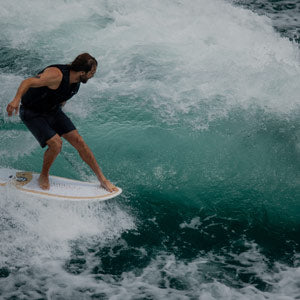
Behind a wakeboard boat optimised for throwing a big, clean wake, the rider uses the wake as a ramp to launch wake-to-wake tricks, spins and inverts. Unlike skiing, it’s judged on style and execution, rather than a fixed points basis.
How it’s scored
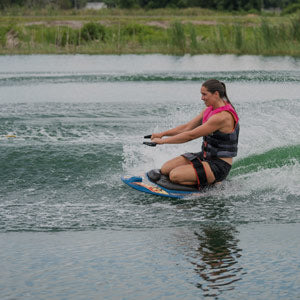
No boat required. An overhead cable system tows riders around a course studded with obstacles — kickers (ramps) and sliders/rails. It’s the most accessible way into the sport and a discipline in its own right.
How it’s scored
You don’t need to be elite to start — clubs run come-and-try days and grading for every level across Australia. Australia’s national governing body for all towed watersports is Waterski & Wakeboard Australia (WAWA), a member of the world federation (IWWF). Find your nearest club and state association through the links below.
Links
Sign up for exclusive deals, latest product drops and more, plus get a first-order discount.
