












Gifting has never been easier
Perfect if you're short on time or are unable to deliver your gift yourself. Enter your message and select when to send it.

Short answer: Lay every component out first and check nothing's missing. Grease every bolt and insert so nothing seizes. Mast to fuselage, then front wing, then stabiliser — torquing as you go. Then mount it to the board through the slide track, wing facing the front of the board, with the mast set toward the back of the tracks for a beginner. And read your model's instruction booklet — not every foil goes together the same way.
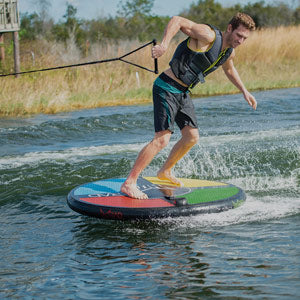
Foiling can be done at any skill level, behind any boat wake. Which makes it worth putting the foil together properly.
The full assembly is below. The written version follows underneath.
Assembling a wake foil and mounting it to the board. 9 min 30 sec.
Take every component out of the foil bag first, so you know you've got the lot:
The booklet is the most important thing in that bag. Not all models go together the same way — some foils assemble a little differently. Follow your model's guide to the absolute letter. What's below is a general guide to the process, not a substitute for it.
Most foil brands ship protective cases over the components. Keep them on whenever the foil isn't in the water — they stop scratches and nicks, and they're what saves the components in transit.
This is the one that gets skipped. Every bolt and every insert gets greased, so nothing seizes during use or when you come to take it apart later.
If your model has a locking collar — check the guide — fill its insert with grease before the collar goes on.
Fit the locking collar to the mast first, if yours has one, and torque it up.
Then lay the mast upside down, flat on the base of the collar. That gives you full access to the underside of the mast, which makes fitting the fuselage and wings much easier than wrestling it upright.
Grease the bolts and inserts again, fit the fuselage, and torque it down.
On most models the front wing slides onto the fuselage and the bolt holes line up as it seats — three bolts on the model in the video, but check your guide.
Slide it on, get the bolts started, then go over every one to make sure it's tight and secure.
Watch the tool grip in the video. There's a different way to hold the tool for spinning bolts in versus torquing them up at the end. It's easier to see than to describe — it's shown around the front wing step.
The stabiliser bolts straight onto the fuselage. There's a flat spot on it that seats against the fuse.
This is also where shims go, if you're using them. A shim is a small plastic or metal insert that sits between the fuselage and the stabiliser and changes the angle of the stabiliser.
For a beginner setup, leave the shims out and run it as designed.
Flip the foil over once the stabiliser is seated — you get much better access to the bolts — and torque them up.
That's the foil assembled: mast, fuselage, front wing and rear wing. Now it goes on the board.
Every foil board, whatever the brand, has a slide track. That's what lets you move the mast fore and aft.
Get the foil out of the road and lay the board down with the mast tracks facing up.
Loosen the mast bolts all the way off. Slot a keeper into the track, slide it to the front, and repeat — all four, one in each corner. Then the mast can sit down on them and you adjust the bolts from there.
Wing facing the front of the board. Make sure you get that right.
For a beginner, position the mast at the back of the mast tracks. Move the bolts so they sit in the counter slots on the mast, set your position, then tighten everything down.
Get down low and check every bolt is properly torqued before it goes near the water.
You don't have to strip it back to components every time. If you've got the room in the vehicle, unbolt the whole lower assembly — mast, fuselage, front wing and rear wing stay together — from the board. That leaves you two pieces.
Wing covers back on, board cover on, and it travels.
Yes. Greasing every bolt and insert is the single most important part of the assembly — it stops them seizing during use and means you can actually get the foil apart again later.
A shim is a small plastic or metal insert between the fuselage and the stabiliser, and it changes the angle of the stabiliser. For a beginner setup, leave them out and run the foil as it's designed.
Further back on the slide track gives less lift, which suits beginners. Further forward gives more lift and a snappier, more responsive setup for advanced riders. Set a beginner at the back of the tracks.
Wing to the front of the board. It's worth double-checking before you tighten anything down.
No. Some models go together a little differently, which is why the instruction booklet for your specific model matters. Follow it exactly — a general guide like this one gets you the process, not the model-specific detail.
Four — one in each corner. Loosen the mast bolts fully, slot each keeper in and slide it forward, then sit the mast on top.
No. Unbolt the lower assembly — mast, fuselage and both wings together — from the board, and travel as two pieces with the wing covers and board cover on.
About this guide. Written from the in-store video demonstration and produced by Waterskiers World — Australia's dedicated towed water sports retailer, family-run for over 20 years from our Brisbane store and online. Not sure which foil setup suits your riding? Talk to our team — we ride this gear.
Sign up for exclusive deals, latest product drops and more, plus get a first-order discount.
