








Gifting has never been easier
Perfect if you're short on time or are unable to deliver your gift yourself. Enter your message and select when to send it.

Short answer: Set the mast all the way back in the slide tracks — that's the least lift and the easiest get-up. Driver holds around 8–10 mph with slow, gradual acceleration. Float on your back with your feet on the board, shoulder-width apart, back foot just in front of where the mast sits, arms straight and loose. As the boat pulls, shift most of your weight onto the front foot to hold the foil down. When the board planes, straighten your legs slowly and stand — knees slightly bent, weight still forward, eyes up.
Wake foiling can be done by any rider, behind any boat wake. Getting up the first time is mostly about setup and staying patient through the pull.
The full run-through is below. Written steps follow underneath.
Getting up on a wake foil, start to finish. 3 min 48 sec.
Start with a foil that suits your level of riding — something more beginner-oriented if you're a beginner rider.
For the setup itself:
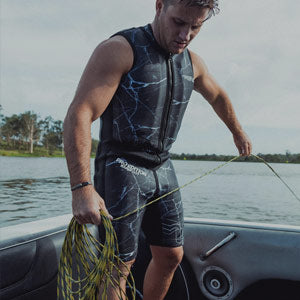
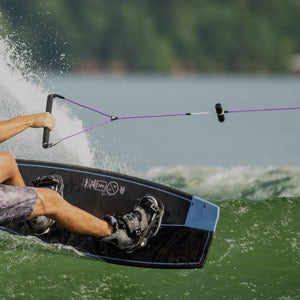
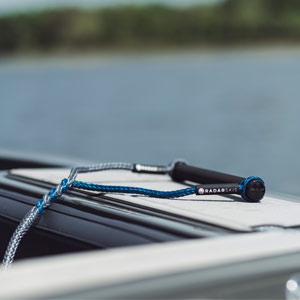
You also want a foil-specific rope — one with sections marked out for foiling — and a rated life vest.
If the foil itself isn't assembled yet, that's covered separately in how to set up your foil.
Speed sits around 8–10 mph — nice and slow.
The acceleration matters more than the number. Super easy, slow, gradual. A sharp pull gives the rider jerking movements and puts them off balance before they've started. Nice easy acceleration is the whole job.
This is the tricky bit, because there's a large foil hanging under the board.
Put the board and foil in the water and push it away from you a little, so you're getting in clear of the foil rather than on top of it.
Do not kick underneath the board. While you're moving around in the water, keep your legs out from under it — you do not want to hit your shin or your feet on the carbon wings or the mast. That's a real injury, not a scratch.
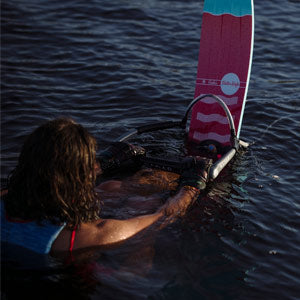
Lie on your back in the water with the board out in front of you and your feet resting on top of it.
Loose is the word that matters. You don't want to be fighting the boat with stiff arms and shoulders.
As the driver starts to pull, the board will start to stiffen up under your feet. Let the boat do the work.
Shift most of your weight onto your front foot. That keeps the foil down and the board on top of the water, which gives you the most stability and makes the get-up as easy as possible.
As you feel the board start to plane on the surface, begin to straighten your legs — slowly, weight still forward on that front foot.
Once the board is planing and you feel stable, gradually stand up. Knees slightly bent. Most of your weight still on the front foot.
Look forward, not down at your feet. If you look down, you'll go down.
Take your back hand off the handle. That squares you up to the wave, and from there you can rotate your shoulders and hips — which is how you turn the foil.
Once you're standing and finding your balance, you control the foil by shifting your weight slightly:
A beginner-level foil with the mast positioned all the way back in the slide tracks, an easy stable wing and a forgiving board. Mast back means the least lift, which is what makes the get-up easiest.
Around 8–10 mph, with slow gradual acceleration. The smoothness matters more than the number — a sharp pull throws the rider off balance.
On top of the board, about shoulder-width apart, with your back foot just in front of where the mast sits.
Most of your weight should be on the front foot through the get-up — that's what holds the foil down and keeps the board on top of the water. Straighten your legs slowly rather than standing all at once, and keep looking forward rather than down.
Take your back hand off the handle. That squares you up to the wave and lets you rotate your shoulders and hips to steer the foil.
Shift your weight slightly back to lift the board out of the water, and forward to lower it back down. Small adjustments.
The foil under the board. Push the board away from you as you get in, and don't kick underneath it — carbon wings and the mast will do damage to a shin or a foot.
About this guide. Written from the video demonstration and produced by Waterskiers World — Australia's dedicated towed water sports retailer, family-run for over 20 years from our Brisbane store and online. Not sure which foil setup will get you up fastest? Talk to our team — we ride this gear.
Sign up for exclusive deals, latest product drops and more, plus get a first-order discount.
