










Gifting has never been easier
Perfect if you're short on time or are unable to deliver your gift yourself. Enter your message and select when to send it.

Short answer: Life vests are graded by level under the Australian Standard. Level 50 and Level 50S have the same buoyancy — the difference is that a Level 50 must be a high-visibility colour and a 50S can be any colour. Neither will turn you face-up if you are unconscious; Level 100 and above are the levels designed to do that, and they are for offshore boating. Which level you are legally required to wear depends on your state and the water you are on — that part is not universal, so check our state-by-state guide. Then get the fit right: snug, like a wetsuit, when it is dry.
Every life vest we stock is Australian Standard approved and carries a 12-month warranty. Reuben goes through the levels, the fit and the different styles in the video below.
Reuben on life vest levels, fit and styles — 6 minutes 21 seconds.
Your vest's level is printed on a label on the inside, along with its weight rating and sometimes chest measurements. That label is the authority — not a product description, and not this page.
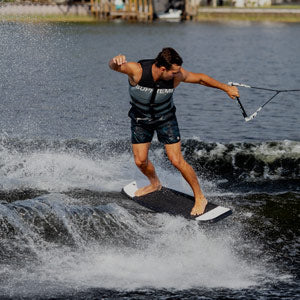
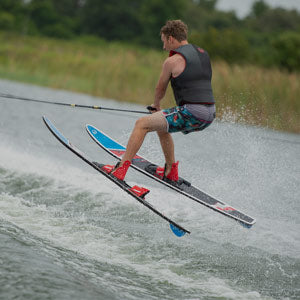
The towed watersports vest most people wear — waterskiing, wakeboarding, kneeboarding, tubing. Any colour is permitted, which is why 50S vests come in every shape, size and colour scheme going.
Same buoyancy as a 50S. The difference is that a Level 50 must be a high-visibility colour, which is why they only come in red, yellow and orange.
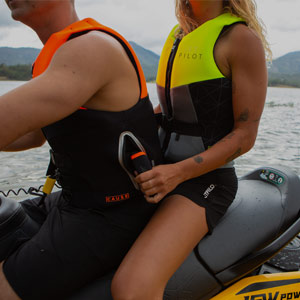
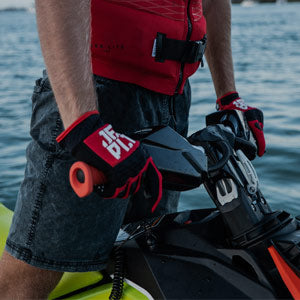
If you are on a jet ski, this is generally the vest to look at, and not only for the rating — Level 50 vests are where the jet ski specific features live:
These are the offshore boating levels. They carry more buoyancy and, unlike Level 50 and 50S, they are designed to turn most unconscious wearers face-up. We hold very limited stock because they are specialised for offshore boating rather than watersports.
Level 50 and 50S are not ranked. One is not an upgrade on the other and neither is more buoyant. The difference is colour and visibility — plus, in some states, which water each one is approved for. Neither self-rights, and neither will keep an unconscious wearer's head above water. That is a Level 100 and above job.
This is the part that is genuinely not universal. Every state and territory sets its own rules, they use different words for the same water types, and one state requires a higher level than the rest in open water. Copy that says "Level 50S is for smooth water only" or "Level 100 cannot be used for towed sports" is describing one state, not the country.
Rather than half-answer it here: our state-by-state life vest guide sets out what each state requires for towed watersports and for personal watercraft, with the source for each. Check it against where you actually ride.
A rated life vest is a legal requirement. For towed watersports and for personal watercraft in Australia, wearing one is not optional and fines apply. The question is only which level, and that is what the guide above answers.
A loosely fitted life vest will not float you properly and can be dangerous. Most vests are neoprene, which stretches by about 5 to 10 percent once it is wet — so a vest that feels comfortable and roomy dry is too big.
Try it on dry and brand new. It should feel snug, like a wetsuit. The zip should sit about 5 to 10 cm apart before you do it up, and the vest should have to stretch to close.
Brands fit differently, so use the size guide on the product page for the vest you are looking at rather than assuming your size carries across. There is more detail in our life vest size guide and in how to fit a life vest properly.
Kids. Fit matters even more here. Get them into the correct weight rating so the vest has enough buoyancy for them, and make sure it is snug around the waist and through the shoulders. Children must never be put in adult-sized vests. There is more in our guide to buying life vests for kids.
A four panel vest has a panel at the front, one either side and one at the back. It fits snugger, with more of a wraparound feel. A two panel vest is cheaper and still a very good vest. Neither is wrong.
Most vests break the flotation into rib-like segments so the vest moves the way your body does. Lots of small segments gives you a really flexible vest; bigger one or two piece segments gives you a stiffer one.
This changes the feel more than people expect. Flotation set lower, away from the chest and shoulders, gives you good range of motion through the shoulders and arms. Flotation set higher towards the shoulders gives a tighter fit around the chest, which some riders prefer.
Oversized armholes give excellent shoulder range. Beyond that there are short cuts, more tapered cuts, and longer cuts for taller riders. Whatever you are doing on the water, there is a vest cut to suit it — and the one you feel most comfortable in is the right one.
They have the same buoyancy. The difference is colour: a Level 50 must be a high-visibility colour, which is why they come in red, yellow and orange, while a Level 50S can be any colour. Some states also treat the two differently for the water you are on, so check the state-by-state guide before you buy.
It depends on your state and on the water you are riding in, and the rules genuinely differ. Our state-by-state life vest guide sets out what each state requires for towed watersports and for personal watercraft.
They were replaced by the AS 4758 levels. PFD Type 1 is now Level 100, 150 or 275; PFD Type 2 is now Level 50; PFD Type 3 is now Level 50 Special Purpose, or 50S. If your vest is marked with a type number rather than a level, it is old stock and several states no longer accept it.
No. Level 50 and 50S vests provide flotation only. Level 100 and above are the levels designed to turn most unconscious wearers face-up, which is why they are the offshore boating levels.
On the inside of the vest, on the label. That is also where you will find the weight rating and, on some brands, chest measurements. The label is the authority on what your vest is, not the product description.
Snug, like a wetsuit, when it is dry and brand new. Most vests are neoprene, which stretches about 5 to 10 percent once it is wet. When you try it on, the zip should sit about 5 to 10 cm apart and the vest should have to stretch to do up. A loosely fitted vest will not float you properly and can be dangerous.
No. Children must never be fitted into adult-sized vests. Get them into the correct weight rating so the vest has the right buoyancy for them, and check it is snug around the waist and through the shoulders.
A four panel vest has a panel at the front, one either side and one at the back, which gives a snugger wraparound fit. A two panel vest is cheaper and still a good vest. Beyond that it comes down to what feels right on you.
It is the segmenting. The flotation is broken into rib-like segments so the vest moves the way your body does. Lots of small segments means a very flexible vest; bigger one or two piece segments means a stiffer one.
Yes. A correctly rated life vest is a legal requirement for towed watersports and for personal watercraft in Australia, and fines apply. Which level satisfies that requirement depends on your state and the water you are on.
Waterskiers World — Australia's dedicated towed water sports retailer, family-run for over 20 years from our Brisbane store and online. Get in touch.
Sign up for exclusive deals, latest product drops and more, plus get a first-order discount.
