








Gifting has never been easier
Perfect if you're short on time or are unable to deliver your gift yourself. Enter your message and select when to send it.

Seven minutes on wakesurf boards with Reuben. Everything below follows the video.
Wakesurfing is the easiest tow sport to learn and the hardest to shop for. Every board looks roughly the same on a rack, and the words on the spec sheet — rocker, rail, thruster, EPS — do not tell you much until someone explains what each one actually does to the ride.
There are three decisions: what size, which style, and what it is built from. Get those three right and almost any board in the range will work for you.
Before anything else — inboard boats only. Wakesurfing must only be done behind an inboard-powered boat, where the propeller sits under the hull. Never behind an outboard or a stern-drive. A wakesurfer rides within a couple of metres of the transom and drops the rope entirely, and an exposed rear propeller in that position is a serious injury risk. This is not a preference or a performance question — it decides whether the sport is safe to do behind your boat at all.
Getting the size right matters more than anything else on this page, and it comes down to three things:
Go bigger if you are a beginner, if you are a heavier rider, or if your boat throws a smaller wave. A bigger board has more volume, which means more stability and more push — and push is what keeps you on the wave when the wave itself is not doing much for you.
Go smaller as you advance, or if you are surfing a big wave. A smaller board is more reactive underfoot. And behind a bigger wave you can afford to lose volume, because that wave carries far more energy — the push is coming from the water instead of from the board.
Those two factors can cancel each other out. A heavier rider behind a big wave and a lighter rider behind a small one can land on the same board. If you are between sizes, tell us your weight and what you are towing behind and we will narrow it down.
You can also filter the range by rider level: beginner, intermediate or advanced.
Once you have a size, the style decides what the board wants to do. There are three, and they are genuinely different boards rather than marketing tiers.
The traditional shape, and what most people picture. You can identify one by three features:
Put together, that makes a stable, carvy board. It wants slow surf-style cutbacks, and the drive to come out of them comes from that wide fish or surfboard tail. If you want the board to feel like a small surfboard rather than a skateboard, this is the one.
Built for tricks, and everything about the shape serves that. The flat rocker gives you top-water speed and glide. The pin tail with a single fin makes it loose and skatey — that combination is what lets you spin 360s and work through the rest of the surface tricks.
You do not have to go single-fin. Skimmers also come in a thruster setup, which is the sensible starting point for a beginner or intermediate rider who knows they want to end up doing tricks but does not want the board sliding out from under them yet.
The last piece is the hard, aggressive rail. It makes the board playful, but it is also doing a structural job: a skimmer has no wide surf tail to generate drive, so all the lift and drive on the wave has to come out of that sharp rail instead.
A hybrid borrows from both, and there are two recipes worth knowing apart — they ride differently:
Fin setups run the full range, from a single fin through to a thruster. If you cannot decide between surf and skim, this is the honest answer: a hybrid is a good all-rounder and you are unlikely to regret it.
Construction sets two things: how well the board performs, and how long it survives being owned. The range runs roughly in price order.
A fibreglass board with a foam soft top. The reason to buy one is not the ride — it is the moment a beginner falls off and the board goes into the boat. With a soft top, neither the board nor the boat gets hurt, and the board picks up far fewer dings and nicks over a season. For absolute first-timers, this is the sensible choice.
A fibreglass sandwich — fibreglass either side of a foam core, compressed — built the same way as a wakeboard. Strong, durable and at a genuinely good price. The trade-off is that it sits a little deeper in the water than the lighter constructions, which you will feel in how the board carries speed.
The value pick. A high-end EPS foam core wrapped in an Enduro shell, so you get the performance of the EPS core with the durability of a compression-moulded board. If you want most of the ride of a high-end board without babysitting it, this is where to look.
Top-end performance. Super responsive, very lightweight, and the best-riding boards we sell. The catch is real: EPS boards are very fragile. They ding and scratch easily, so you have to be careful with them in the board racks and moving around the boat. Buy one because you want the ride, and then look after it.
A carbon fibre laminate over a foam core. Same responsive, lightweight performance as EPS, but noticeably more durable — you still would not want to drop one, but it is not in the same fragility bracket. The downside of carbon is the price tag, not the toughness.
Worth being clear on this, because the two get lumped together: EPS and carbon are not equally fragile. EPS is the delicate one. Carbon costs more but holds up better.
A lot of people assume wakesurfing requires a half-million-dollar wake boat. It does not. With a wake shaper and a set of ballast bags, plenty of ordinary inboard boats will throw a wave that is genuinely surfable — a fifteen-year-old direct-drive with a shaper fitted and some weight on board will give you a proper session.
We stock wake shapers and a range of ballast to suit boats of all shapes and sizes. It is worth a conversation rather than a guess — how much weight you add, and where you put it, changes the wave completely, and the right setup is different for every hull. Tell us what you are running and we will work out what it needs.
The one thing a shaper cannot change is the drivetrain. It has to be an inboard.
Three factors: your weight, your boat’s wave size and your ability. Bigger boards carry more volume, so they are more stable and give more push — better for beginners, heavier riders and smaller waves. Smaller boards are more reactive, and you can go smaller behind a bigger wave because the wave supplies the push instead of the board.
A surf-style board has a thicker rail, a fish or surfboard outline and a thruster or quad fin setup — stable, carvy, drive coming off a wide tail. A skim board has a flat rocker for glide speed, a pin tail with a single fin so it stays loose, and a hard rail that supplies the lift and drive the narrow tail cannot.
If you cannot decide between surf and skim, yes. Hybrids pair a surf outline with a skim rail, or a skim profile with a surf rail, and run anything from a single fin to a thruster. They are a good all-round board.
No. Wakesurfing must only be done behind an inboard-powered boat, where the propeller is under the hull — never behind an outboard or a stern-drive. The rider sits close behind the transom with no rope, which makes an exposed rear propeller a serious risk. Given an inboard, a wake shaper and ballast will get a surfable wave out of a lot of ordinary boats.
Around 16 kph. The speed is set to shape the best wave, not to make the ride easier or harder for the rider — too fast and the wave flattens out, too slow and it falls apart.
Soft tops for absolute beginners, because a board that hits the boat damages neither. After that, compression-moulded fibreglass and Enduro Shell are the durable options. EPS is the most fragile despite being the best performer; carbon fibre is more durable than EPS, and its real downside is price.
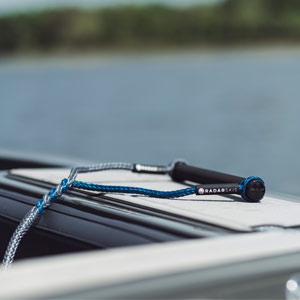
Yes. You start on the rope exactly like wakeboarding, and only drop it once the wave has taken you. A wakesurf-specific rope and handle is shorter and built to be dropped and retrieved repeatedly.
Two of our other guides pick up from here: how to set up your wakesurfer covers fins and stance, and getting up on a wakesurfer covers the start. You will also want a wakesurf rope and handle, and a properly fitted life jacket — the requirements are set state by state, so check the state-by-state guide for where you ride.
You can see the full wakesurfer range here, or come and stand on a few in our shop at Moorooka, Brisbane. If you tell us your weight and what boat you are behind, we can usually get you to two or three boards in about a minute.
Presented by Reuben at Waterskiers World, Moorooka, Brisbane. If something here does not match the board in front of you, give us a call and we will sort it out.
Sign up for exclusive deals, latest product drops and more, plus get a first-order discount.
