










Gifting has never been easier
Perfect if you're short on time or are unable to deliver your gift yourself. Enter your message and select when to send it.

Five and a half minutes on tournament ropes and handles with Reuben. Everything below follows the video.
This one is for skiers who are serious about the course. Where social ropes and handles are built to cover everyone on the boat, tournament gear is specific to a single event — slalom, trick or jump — and it is built to do that one job properly.
It is also the point where the decisions become genuinely personal. A lot of what follows comes down to what feels right in your hands, and that is not a cop-out — at this level, the handle you are most comfortable holding is the handle you will ski best on.
Two numbers define a slalom handle, and both are adjustable to you:
That diameter range is narrower than it sounds and it makes a real difference in the hand. Bigger hands generally want more diameter. So do people who grip the handle firmly through the whole pass. If you carry the handle more on your fingers than in your palm, you will usually prefer a thinner one. There is no correct answer here — it is genuinely personal preference.
Some slalom handles are noticeably bent rather than straight. That shape is doing one specific job: reducing forearm pump.
If you are skiing a lot of sets and your forearms are burning out before your legs do, a radius or bent handle is worth trying. It will not make you a better skier on its own — but skiing more sets, more comfortably, will.
You will see some handles with a protective poly coating on the rope. It does what it says: the coating makes the rope last longer.
Not everyone wants it. Some skiers find the coating makes the handle feel too heavy, and prefer to go without. Neither choice is wrong — at this level, go with whatever you think will make you ski best and feel most comfortable in the course.
Same idea, different numbers. Jump handles run 10, 11 and 12 inches wide, and you can play with the diameter the same way you would on a slalom handle.
What changes is the rope on the end of it. A jump setup pairs the handle with a stronger, less stretchy rope, because a jumper is relying entirely on line tension to hit the ramp at the best speed they can. Speed into the ramp is pop, and pop is distance — so anything the rope absorbs is length you do not get.
The trick handle is the most distinctive of the three, because it has two features the others do not.
A trick handle carries a toe hold — the section you put your foot into for the toe pass, so you can spin and trick with the handle on your foot instead of in your hands. It is the single most important feature on a trick handle.
You have a choice here: with a bear trap, or without one. Decide which you want before you order, because it is not something you retrofit.
The other feature people miss. Trick handles have a braid, and it is there for wrap tricks — you hold the braid rather than the handle so you can get the big spins around, and hold the line tension you need to get the pop off the wake.
Like the handles, the ropes are event-specific. Three different constructions doing three different jobs.
A slalom rope works like a social ski rope in principle — sectioned, shortenable — but with more sections, and starting a lot shorter. Instead of 70 feet, a tournament slalom rope starts at 60 feet, or 18.25 metres. That is the starting length to get into a slalom course.
From there the shortening runs down through the standard lengths. Some ropes take you to 10.75 metres. Others go all the way to 9.25 metres — which is what the best skiers in the world are attempting.
This is the choice most people do not know they are making, and it matters more than the rest of the rope.
Why the slide loop exists. In the slalom course there is a great deal of load going through the centre ski pylon and through the rope. A knotless loop under that much tension is not something you want to be wrestling on and off between passes. If you are changing lengths quickly, or putting a lot of load on the line, the slide loop is the one to go for.
Built completely differently to a slalom rope — much stiffer, with far less stretch. Two options:
The reason to go with no stretch: more consistent edge hold into the wake, and more consistent pop off it. In tricks you are trying to land spins and flips as fast as the rules allow, and inconsistent line tension is what breaks that rhythm.
Our top-line jump ropes are a combination of Spectra and Poly P. That mix gives you strong line tension with a little bit of forgiveness — which matters, because jumpers are loading the ski extraordinarily hard to carry the most speed and the best angle into the ramp.
Browse the full tournament range, or narrow to handles or ropes and main lines. There is more course gear in tournament ski equipment.
Sixty feet, or 18.25 metres — the starting length to get into a slalom course, and a good deal shorter than the 70 feet a social ski rope starts at. From there ropes shorten through the standard lengths; some run to 10.75 metres and some all the way to 9.25 metres, which is what the top skiers in the world are attempting.
A knotless rope has a loop in the middle that goes over the centre ski pylon, much like a standard ski rope. A slide loop splices into itself, so it unloops and slides on and off the pylon easily. Because there is a lot of load on the pylon and the rope in the course, the slide loop is the better choice if you are changing lengths quickly or loading the line hard.
A bent or radius handle reduces forearm pump. If you are skiing a lot of sets and your forearms are fatiguing, it lets you ski more sets and ski them more comfortably.
Widths run 12 to 13 inches and diameters run 0.94 to 1.183 inches. It comes down to your hands and your grip — bigger hands and a firm full-palm grip generally suit more diameter, while holding the handle more on the fingers suits less. There is no right answer; it is personal preference.
It makes the rope last longer. The trade-off is weight — some skiers find a coated handle feels too heavy and prefer to go without. Both are legitimate choices.
Two things. A toe hold, which your foot goes into for the toe pass so you can spin with the handle on your foot, available with or without a bear trap. And a braid, which you hold instead of the handle for wrap tricks so you can carry the spin and hold line tension for the pop off the wake.
A stiff, low-stretch rope. Poly-E trick ropes still have a little bungee in them; the top-line option is a Spectra core with no stretch at all. No stretch gives more consistent edge hold into the wake and more consistent pop off it.
Top-line jump ropes combine Spectra and Poly P. That gives strong line tension with a little forgiveness, which suits the very high loads jumpers put through the ski carrying speed and angle into the ramp.
If you are buying tournament ropes you are probably tuning everything else too: choosing a slalom ski, setting one up, and setting up a trick ski. The slalom ski and trick ski ranges are here.
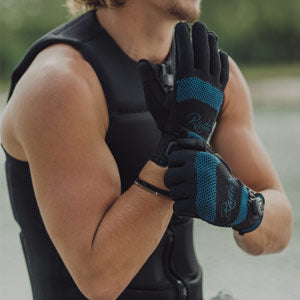
Two practical things at this level. Gloves matter more the harder you load the handle — here is how they are meant to fit. And check your rope for frays regularly, because a line that lets go at 9.25 metres is not a small event. If you are swapping a handle between lines, here is how to disconnect and reconnect it.
Vest requirements are set state by state — check the state-by-state guide and the vest range for where you ski.
Come into the shop at Moorooka, Brisbane and hold a few. Diameter and bend are decided in the hand, not on a spec sheet.
Presented by Reuben at Waterskiers World, Moorooka, Brisbane. If something here does not match the handle in front of you, give us a call and we will sort it out.
Sign up for exclusive deals, latest product drops and more, plus get a first-order discount.
