









Gifting has never been easier
Perfect if you're short on time or are unable to deliver your gift yourself. Enter your message and select when to send it.

Eight minutes on wake foils with Reuben. Everything below follows the video.
Wake foiling is the newest sport on the water and it is taking over, for one simple reason: you do not need a wake boat. A foil will fly off a jet ski wave, off a small ski boat, or out in the surf. If you have been sitting out wakesurfing because your boat does not throw a big enough wave, this is the answer.
It is also easy to learn with the right setup — and much harder than it needs to be with the wrong one. A foil is five separate components, and each one has a length or a size that changes how the whole thing rides. Once you know what each part does, buying one stops being guesswork.
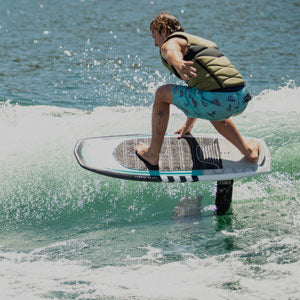
You ride a board that looks much like a wakesurfer, but with a hydrofoil bolted underneath. As water runs over the front wing it generates lift, and the board and rider rise clear of the surface with only the mast cutting through the water. Shifting your weight back changes the foil’s angle of attack, the board lifts, drag drops away, and you are flying.
What holds you up is the pressure pulse from the water the boat has displaced, reforming behind it into a wake. Position the foil correctly in that pulse and it pushes you along. The start itself is close to a wakesurf start — we cover it separately in getting up on a foil.
The foil assembly is four parts plus the board: board, mast, fuselage, front wing, rear wing.
Very similar to a wakesurf board, but shaped to take the foil assembly — the outline is built to keep you stable and in control once you are up on the foil.
Worth knowing before you spend the money: a lot of our foil boards double as a wakesurf board. Take the foil assembly off, screw the fins in, and you have a surfer. If you are weighing up a foil against a wakesurfer, that changes the maths.
The vertical strut that joins the board to the fuselage. Masts come in a range of lengths, and the length changes the ride: a shorter mast is more stable and more forgiving, which is why beginner setups run one. A longer mast gives you more room to move and more speed, and it is what you graduate to.
The horizontal spine that connects the mast to the front and rear wings, and balances the whole foil. Length matters here too, in a straightforward way:
The part that does the work. Water running over the front wing is what generates lift, and it comes in a wide range of sizes and styles to suit different riding styles and skill levels. This is the single component that most changes how a foil feels, and it is the first thing most riders upgrade.
Sits at the back of the fuselage and counterbalances the lift the front wing is making. That balance is what stabilises the ride — without it the front wing would simply pitch you up. It is also swappable, so it is another lever for changing how the foil feels once you know what you want from it.
You will hear the term thrown around constantly. Aspect ratio is the ratio of the wing’s span to its depth — a long, thin wing is high aspect; a short, deep wing is low aspect. It is one of the biggest factors in how a wing performs.
Wing size sets your overall stability and how efficiently the foil moves through the water. A larger wing is more stable and easier to ride; a smaller wing is faster and more responsive.
Your weight belongs in this decision, not just your skill level. A larger rider needs a larger wing simply to generate enough lift for their weight. A lighter rider can run a smaller wing and get the extra speed and response for free. Two riders of the same ability and different weights should not be on the same wing.
Foil boards are sized much the same way as wakesurfers. A bigger board is easier to ride and less responsive, and it carries a heavier rider better. A smaller board reduces your turning radius and lets you turn quicker and more efficiently.
Start big. When you are learning, a big foil board makes the ride as easy as it can possibly be. Once you want to start throwing the foil around, drop down a size. There is no prize for starting on a small board.
Construction is what separates an entry-level setup from a top-end one, and it drives most of the price difference.
The mast and fuselage choice is the one that most dictates both your performance and the price of the setup. Alloy is the beginner option and there is nothing wrong with learning on it.
If you are starting out, buy a kit. We put our foil kits together ourselves so that the wing, mast, fuselage and rear wing actually suit each other and suit your level — there are beginner, intermediate and advanced kits. A complete kit includes the board as well; a foil kit is the assembly on its own, for someone who already has a board.
Plenty of advanced riders skip the kits and buy individual parts instead, building exactly the ride they want. If you are at that stage you already know which wing you are chasing. Boards on their own are here too.
This is the best thing about foiling. Nothing is a dead end. Stuck with a big bulky front wing you have outgrown? Unbolt it and bolt on a smaller, more efficient one, and the whole feel of the foil changes. Same with the rear wing, the fuselage and the mast. You can go looser and faster, or longer and more stable for a cruisy afternoon, without buying another foil.
The one catch: parts only interchange within the same brand. Armstrong, Liquid Force and Ronix each have their own upgrade paths, mounting systems and part ranges. An Armstrong wing will not go onto a Ronix mast. That makes your first brand choice a longer-term decision than it looks — you are choosing the ecosystem you will upgrade inside for years.
A foil is not a wakeboard. It is a set of thin carbon blades on a strut, and it needs to be treated differently — both for the gear’s sake and for everyone in the water.
Covers and hardware are in surf and foil accessories.
No — that is the main appeal. A foil will fly off a jet ski wave, a small ski boat, or a wave out in the surf. You do not need a large wakeboard boat and you do not need ballast.
A larger front wing with a shorter mast, on a larger board, with an alloy mast and fuselage and a fibreglass board. Buy it as a beginner kit rather than assembling it yourself — the parts in a kit are matched to work together and to suit your level.
A shorter mast is more stable and more forgiving, which is why beginner setups use one. A longer mast gives more speed and more room to manoeuvre, and is what intermediate and advanced riders move to.
A shorter fuselage makes the foil more manoeuvrable. A longer fuselage gives smoother turns.
The ratio of the wing’s span to its depth. Higher aspect ratio — long and thin — means more speed and responsiveness, which suits advanced riders. Lower aspect ratio means more stability, which suits beginners.
Yes, and it is often overlooked. A larger rider needs a larger front wing simply to generate enough lift for their weight. A lighter rider can run a smaller wing and gain speed and responsiveness. Skill level alone is not enough to size a wing.
No. Parts only interchange within the same brand. Armstrong, Liquid Force and Ronix each have their own mounting systems and upgrade paths, so your first brand choice decides which ecosystem you upgrade inside later.
Many of them can. Remove the foil assembly, fit the fins, and it rides as a wakesurf board. Check the individual board before you buy if that matters to you.
Yes. We keep a range of demo foils. If you are in the Brisbane area, come and see us and we will get you set up on one.
Once you have a setup, how to set up your foil covers assembly and adjustment, and getting up on a foil covers the start. You will want a surf rope and handle, and a properly fitted life jacket — the requirements are set state by state, so check the state-by-state guide for where you ride. If you are still deciding between a foil and a surfer, the wakesurf board breakdown is the other half of the picture.
We keep demo foils. Foiling is the one category where twenty minutes on the water tells you more than any amount of reading, so if you are in Brisbane come to the shop at Moorooka and get on one. Or see the full foil range here.
Presented by Reuben at Waterskiers World, Moorooka, Brisbane. If something here does not match the foil in front of you, give us a call and we will sort it out.
Sign up for exclusive deals, latest product drops and more, plus get a first-order discount.
