









Gifting has never been easier
Perfect if you're short on time or are unable to deliver your gift yourself. Enter your message and select when to send it.

Four minutes on wakeboard ropes and handles with Reuben. Everything below follows the video.
There are a lot of wakeboard ropes on the wall and most of them look interchangeable. They are not. There are three decisions in front of you — how much the rope stretches, how long it is, and what the handle does — and each one changes how the boat pulls you into the wake.
Here is what separates them.
A water ski rope has stretch in it on purpose. Skiing happens at much higher speed, and that stretch is forgiveness — it takes the edge off the load.
Wakeboarding happens at much slower speed, so you do not need that forgiveness. What you want instead is a non-stretch or low-stretch rope, which gives you a consistent pull off the boat. That consistency does two things:
That is the whole argument for a wakeboard-specific rope: at wakeboard speeds, stretch is not helping you.
Wakeboard ropes run from about 70 to 85 feet, with multiple adjustable sections so the length can be changed between riders without swapping ropes. That flexibility matters more than it sounds when four people of different ability are taking turns behind the same boat.
Pull a beginner in close and they are jumping a narrower part of the wake. That is the whole point. It builds confidence, it builds good habits, and critically it means they land on the downside of the wake rather than flat — which is what saves their knees and stops the ride ending in a heavy landing.
Faster boat speed and a bigger wake means an advanced rider can run the rope out to 80 or 85 feet and dial in exactly where they want to sit on the wake to get the best pop and make the trick look right.
Changing length is a two-minute job at the boat, not a purchase decision — see how to shorten your ski or wakeboard rope. Take the load on the bite of the rope, not on the knot.
There are three materials on the wall, in two groups: one low-stretch, two non-stretch.
The budget-friendly option, and a genuinely good one — you do not have to break the budget to get a rope and handle that works. Poly-E has a little forgiveness and a little stretch in it, but plenty of performance for someone getting into wakeboarding.
Check the length before you buy. Low-stretch Poly-E ropes normally come in shorter lengths, around the 70-foot mark. That is deliberate — it suits the beginner riders they are built for, who want to be in close on a narrow part of the wake. But if you are expecting to let a rope out to 85 feet later, this is not the one.
A true non-stretch line, for riders who want maximum performance: more consistent edge hold into the wake, and more lift and pop off it. Spectra lines come with a PVC coating, which protects the line from things like sun exposure.
The higher-quality line, and the more expensive one. Two practical differences over a PVC-coated Spectra:
Both Spectra and Dyneema are normally offered in 80 to 85 feet with multiple sections, so you can shorten right down for a learner and let it all the way out for yourself. Browse the non-stretch ropes.
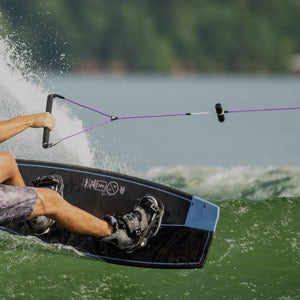
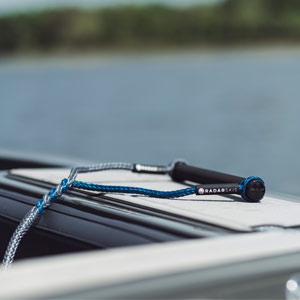
A wakeboard handle is 15 inches wide. A water ski handle is normally 12 or 13. That is not a styling choice — the handle has to pass around your back when you spin, and a wider handle makes those handle passes much easier. If you have ever fumbled a pass on a narrow handle you already know why.
There are two different things being called “floating”, and they do not perform the same.
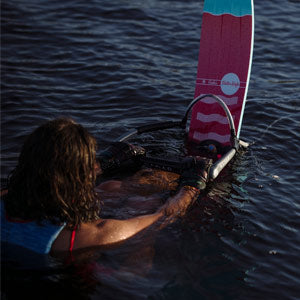
Handles with floats fitted — a physical float on the handle — stand up on top of the water, which makes rider pickups easy.
Pro handles get their flotation from foam injection or sealed end caps instead, to keep the shape clean. They do float — but not as well as a handle with floats on it. Worth knowing before you buy, especially if you are often picking the handle up off the water.
If you are buying the handle on its own rather than as a package, handles are listed separately here, ropes on their own here, and complete packages here.
You can, but it will work against you. Ski ropes are built with stretch because skiing happens at much higher speed and that stretch is forgiveness. Wakeboarding is slower, so you want a non-stretch or low-stretch line for consistent pull, better edge hold into the wake and more pop off it.
Between about 70 and 85 feet. Beginners should be in short — a narrower part of the wake to jump, which builds confidence and means they land on the downside of the wake rather than flat. Advanced riders at higher boat speed with a bigger wake let it out to 80 or 85 feet.
Both are non-stretch. Spectra lines come with a PVC coating that protects them from sun exposure. Dyneema is the higher-quality option — more expensive, but lighter and it does not tangle as much as the PVC-coated Spectra lines.
For someone getting into wakeboarding, yes. It has a little stretch and a little forgiveness in it but plenty of performance, at a much friendlier price. Just check the length — Poly-E ropes normally come around 70 feet, so they will not let out to 85 later.
A wakeboard handle is 15 inches against 12 or 13 for a water ski handle, because the handle needs to pass around your back when you spin. The extra width makes handle passes considerably easier.
It depends which kind. Handles with floats fitted sit up on the surface and are easy to pick up. Pro handles float using foam injection or sealed end caps instead, which keeps the shape cleaner but does not float as well. If easy pickups matter to you, buy the one with floats.
A package is the simplest way to get a matched rope and handle in one go. Buying separately makes sense when you want a particular handle, or when you are replacing one half of a setup you already like.
A rope is a wear item. Check it for frays regularly — here is what to look for — because a line that lets go under load is not something you want to find out about mid-wake.
Also worth a look: setting up your wakeboard, picking the right board, and a properly fitted life jacket. Vest requirements are set state by state, so check the state-by-state guide for where you ride.
The full wakeboard rope and handle range is here, or come and pick a few up in the shop at Moorooka, Brisbane — handle feel is worth thirty seconds in your hands.
Presented by Reuben at Waterskiers World, Moorooka, Brisbane. If something here does not match the rope in front of you, give us a call and we will sort it out.
Sign up for exclusive deals, latest product drops and more, plus get a first-order discount.
