









Gifting has never been easier
Perfect if you're short on time or are unable to deliver your gift yourself. Enter your message and select when to send it.

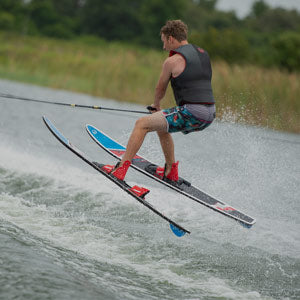
Short answer: We split slalom skis into four categories. Social Cruiser is the widest and easiest — best at slower boat speeds, easiest deep water starts. Social Carver is mid-width with a deeper concave, for competent skiers who want the ski to do more through the turn. Performance is carbon, stiffer, with an adjustable tail block, for experienced skiers at higher speeds or starting the course. Tournament is a narrow, rigid, expert-level course ski for 32 to 36 mph. Your size, separately, comes down to your weight and your boat speed.
There are a lot of slalom skis on the market and the spec sheets do not make it obvious which one is for you. Reuben splits the whole category into four groups in the video below, and explains what actually changes between them — width, concave, core and bevel — so you can place yourself.
Reuben on the four slalom ski categories — 5 minutes 28 seconds.
Who it is for: people learning to ski, and anyone who wants something effortless and easy to ride.
These are the widest skis in the range, and that width does two things. It gives you better performance at slower boat speeds, and it makes deep water starts an absolute dream — the extra width creates more lift, so you get more turns for less effort.
Pair that with a shallow concave and you get a smooth, predictable turn rather than one that catches you out.
Construction: a carbon fibre or fibreglass laminate over a polyurethane foam core. Polyurethane is a forgiving material, which is what makes these skis suit rougher water — lakes and dams rather than glass.

Who it is for: competent skiers who want the blend of performance and forgiveness — the next step up from a Cruiser.
These are mid-width with a deeper concave. The deeper concave means the ski does more of the work through the turn and changes edge more responsively, so your turns start linking together — and that is where the big spray everyone is chasing comes from.
Construction: still a polyurethane foam core, so still forgiving, with a fibreglass or carbon fibre laminate.

Who it is for: experienced skiers starting to run the course, or anyone wanting an aggressive open-water ski.
Performance skis are primarily carbon fibre, with a fuller, deeper edge-to-edge concave that prioritises performance at higher boat speeds. The core and layup are stiffer, and the bevel package is harder, so the ski comes through the turn quicker and more aggressively with a sharper edge change.
This is also where you start seeing a different tail block — fully adjustable, so you can dial in how the ski rides to match your style and what you want out of it.

Who it is for: expert skiers running the slalom course, typically at 32 to 36 mph (roughly 51 to 58 km/h), and anyone chasing the highest performance available.
The core is a lightweight, rigid foam that is around seven times more responsive than a standard foam core, wrapped in very high quality carbon fibre for the response you need chasing buoys through the course.
A narrow profile, a full edge-to-edge concave and a more aggressive bevel mean the ski rolls onto edge harder and gives you minute control over what it does. That control is only an advantage if you are at expert level — this is a demanding ski, not a fast one you grow into.

Category picks the ski. Weight and boat speed pick the size. They are two separate decisions and both matter. Once you know which category you are in, put your weight and your usual boat speed into our slalom ski size calculator and it will give you the right length.
Social Cruiser, Social Carver, Performance and Tournament. They differ in width, how deep the concave is, how stiff the core is and what boat speed they are built around — and each one suits a different level of skier.
A Social Cruiser. They are the widest skis in the range, which means more lift, easier deep water starts and better performance at slower boat speeds, with a shallow concave that gives a smooth, predictable turn.
Size comes down to two things: your weight and your boat speed. Put both into our slalom ski size calculator and it will tell you which length suits you.
Polyurethane is forgiving, which is why Cruiser and Carver skis handle rough water on lakes and dams well. The lightweight rigid foam used in tournament skis is around seven times more responsive, which is what expert skiers want and what makes those skis unforgiving for everyone else.
It controls how much work the ski does for you through the turn. A shallow concave gives a smooth, predictable turn. A deeper concave makes the ski turn harder and change edge faster, which is more performance and less forgiveness.
It is the mounting block at the tail that holds the fin, and on Performance and Tournament skis it is fully adjustable. That lets you tune how the ski rides to match your style, rather than being stuck with the factory setting.
Not unless the way you ski calls for it. Carbon adds stiffness and response, which is an advantage at higher boat speeds and in the course, and a disadvantage if you are still learning — a stiffer ski is less forgiving of mistakes.
You can, but it is built for course speeds of 32 to 36 mph and expects an expert skier. For open water, a Performance ski gives you most of the response with considerably more forgiveness.
Still not sure where you sit? Give us a call — tell us your weight, your boat speed and what you want to be doing in two seasons, and we will point you at the right category.
Waterskiers World — Australia's dedicated towed water sports retailer, family-run for over 20 years from our Brisbane store and online. Get in touch.
Sign up for exclusive deals, latest product drops and more, plus get a first-order discount.
