









Gifting has never been easier
Perfect if you're short on time or are unable to deliver your gift yourself. Enter your message and select when to send it.

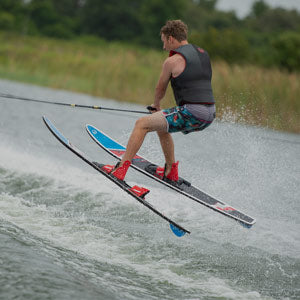
HO slalom skis — the full HO ski range, sold as complete packages with matched boots and rear toe plates. Beginner cruisers through to tournament 3-Event, mens, womens and kids.
Why HO. HO has been in slalom skiing for over 50 years — one of the longest-running brands in the sport. The lineup splits neatly into oversized beginner cruisers, intermediate carving shapes, and tournament 3-Event skis. Each tier is paired with the right boot system for the rider it’s aimed at. Sold as complete ski packages. HO skis in this collection are sold as the ski PLUS the matched boot system PLUS a rear toe plate (RTP) for the back foot. You don’t source boots separately — the package is the ride. Boot tier varies with ski tier: open-toe lace-and-Boa boots for intermediate progression, dual-lace and hardshell systems for advanced tournament work. Skill levels in the range. Beginner and oversized shapes — maximum width through tip and tail, huge surface area, effortless lift, deep starts a breeze. For first-timers, returning skiers, heavier riders, and family-shared skis. Forgiving and confidence-building. The benchmark for “give me the ski that just gets me up”. Intermediate and hybrid shapes — narrower tail than the oversized cruisers, but still wider than tournament. Multi-skill range coverage (kids through womens and mens). Suits 26-32 mph boat speeds. Some include the Clean Edge tail feature for reduced drag and easier turn linking — helps progression riders focus on body position. Advanced and tournament 3-Event shapes — narrow tail, sharper rails, more responsive rocker. Designed for 32-36 mph boat speeds and serious course work. Multiple build tiers within the advanced lineup. Mens, womens and kids. Womens-specific skis account for typical womens body weight and skiing speed — they’re not shorter mens skis. Kids skis are scaled to junior body weight and progression speeds. Boot pairings. Each ski tier is paired with a boot tier matched to the rider’s skill: open-toe boots with lace or Boa adjustment for intermediate progression, dual-lace and hardshell boot systems for advanced and tournament work. The rear is usually a rear toe plate (RTP) for easy release on falls; the highest-spec tournament packages use a fixed rear boot for precise back-foot control. Sizing. By rider weight AND boat speed — use the manufacturer chart on each product page. As a general rule, beginners and returning skiers should go one size longer than the chart suggests. More ski equals more lift equals easier start equals more forgiving equals less tiring. You can size down later as you progress. Fin and foil. Skis arrive with factory fin and foil settings — these are the result of professional R&D and should be left alone until you’re competent enough to know what you’re changing. Factory settings are typically a 7° foil down angle. Don’t go below 6° — risk of tail blowout. Try Before You Buy. Selected HO skis are in our demo fleet. Hire fees vary by product.
Sign up for exclusive deals, latest product drops and more, plus get a first-order discount.
