










Gifting has never been easier
Perfect if you're short on time or are unable to deliver your gift yourself. Enter your message and select when to send it.

Short answer: Find your tow point first, then match the method. A recessed bollard takes the rope loop straight over it; an unrecessed one needs a figure eight. A ski hook takes the loop up from the rear over the central prong. A jet ski cleat takes the rope up through the centre hole and over the recessed sides. Anything with only a closed D-ring wants a quick connect left permanently in place. And any boat with no centre tow point at all — outboard, tinny, jet ski — uses an outboard bridle with a pulley in the middle, attached with snap hooks or, on handles, with two jet ski quick connects.
There are a lot of different tow points out there and the right method depends entirely on which one your boat has. Below is every common type, in the order Reuben works through them in the video, with what goes where.
Reuben on every common tow point, with real examples of each — 7 minutes 38 seconds.
The most common tow point there is, seen on wakeboard boats, ski boats and jet skis. A bollard sits on a ski pylon, a wake tower, or on some transom mounts. If it has a recess, just loop the rope's looped end over it. Done — the recess holds it.
If the bollard or pylon has no recess to hold the loop, make a figure eight: loop it over, twist, and loop it over again. That pulls up nice and tight and stops it working its way off.
Common on ski boats and on the transom of some crossover boats. It is a ring with a spoke through the middle. Bring the looped end of the rope up from the rear of the boat, hook it over the central prong, and pull forward towards the rider. Quick, and secure once it is loaded.
Many jet skis have a centre tow cleat: a hole through the middle with recessed sections either side. Feed the rope up through the centre hole, loop it over the recessed sections on each side, and pull tight back towards the rider.
No cleat, just a closed D-ring on the back? You can pass the rope through and pull it back through itself, but it is slow and the knot pulls up so tight it becomes difficult to undo. Better: fit a jet ski bridle or quick connect. Loop it through the D-ring and back on itself, and leave it there — it stays on the ski. Then thread your tow rope through the middle and back on itself. Swapping between a ski rope, a wake rope and a tube rope becomes a ten-second job.
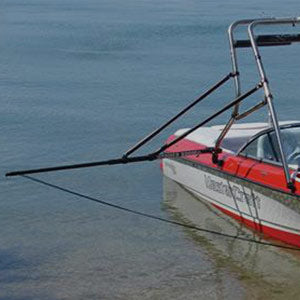
An outboard bridle is a length of rope with a pulley in the middle. The two looped ends attach to the outside of the vessel, one each side, and the pulley keeps the pull consistent and centred behind the boat. Your tow rope then attaches to the pulley.
Common on outboard ski boats and outboard fishing boats. These are open D-rings with a clip. Loop one end of the bridle over the hook and seat it under the clip so it cannot slip off, then repeat on the other side. Thread the tow rope through the pulley in the middle and back on itself.
If the D-rings are closed and your bridle's loops cannot pass through them, you need snap hooks. You can buy them separately, or buy an outboard bridle with them already fitted. Snap one onto each D-ring, then attach the tow rope to the bridle as usual.
Snap hooks will not work here, because the handles are too thick for them to close around. Instead use two jet ski quick connects, looping each one back on itself around a handle. Then attach the outboard bridle's loop ends to the quick connects the same way — through the centre and back on itself. You now have a secure, centred tow point on a boat that was never built with one.
From the shop — match the rope to what you are towing. A single-person rope is not strong enough for a multi-person tube and can break under load, which is dangerous. The reverse is fine: a four-person rope on a one-person tube just adds a bit of weight and drag. If you are in any doubt, buy the stronger rope. Standard tube rope length is 60 feet (18.25 m), which is what keeps the tube clear of the chine spray coming off the boat, and an elevated tow point keeps the rope out of the water and cuts the spray further.
If the bollard is recessed, simply loop the rope's looped end over it and go. If there is no recess, make a figure eight — loop it over, twist, loop it over again — so it cannot work its way off.
If the jet ski has a centre tow cleat, feed the rope up through the centre hole and loop it over the recessed sections either side, then pull tight. If it only has a closed D-ring, fit a jet ski bridle or quick connect to the D-ring and thread your rope through that.
It is a short loop that stays permanently on your jet ski's D-ring. Without one you have to thread the rope through the D-ring and back through itself, which pulls up into a knot that is difficult to undo. With one, swapping between a ski rope, a wake rope and a tube rope takes seconds.
An outboard bridle. It is a rope with a pulley in the middle: the two loop ends attach to the outside of the boat, one each side, and the pulley gives you a consistent, centred pull. Your tow rope attaches to the pulley.
Not directly — snap hooks are too small to close around a handle. Use two jet ski quick connects instead, looped back on themselves around each handle, then attach the bridle to those.
Use snap hooks. You can buy them on their own, or buy an outboard bridle that already has them fitted.
No. A single-person rope is not strong enough for a multi-person tube and can break dangerously. Going the other way is fine — a four-person rope on a one-person tube just means extra weight. If you are unsure, buy the stronger rope.
The standard is 60 feet, about 18.25 metres. That is the distance that keeps the tube clear of the chine spray coming off the boat.
If none of the tow points above look like yours, send us a photo of the back of your boat. We will tell you what you need — we have not been beaten by one yet.
Waterskiers World — Australia's dedicated towed water sports retailer, family-run for over 20 years from our Brisbane store and online. Get in touch.
Sign up for exclusive deals, latest product drops and more, plus get a first-order discount.
