

















Gifting has never been easier
Perfect if you're short on time or are unable to deliver your gift yourself. Enter your message and select when to send it.

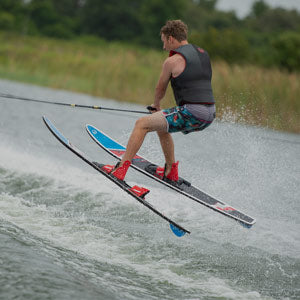
Womens slalom ski boots and rear toe plates — sold separately for fitting your own bindings. Radar, KD, HO and Connelly. Open-toe and rear toe plate options.
Why womens-specific. Womens slalom ski boots aren’t just smaller mens boots — they account for typical womens foot shape (narrower heel, different forefoot proportions) and lower body weight. Flex is usually softer, the cuff is shaped differently, and the overall feel is tuned for less aggressive load on the ankle and lower leg. A properly fitted womens boot makes a noticeable difference in comfort and response on the water. When to buy boots separately. Most womens recreational and intermediate skiers buy a complete ski package (ski + matched boots + rear toe plate). Sold separately, womens boots are for skiers fitting their own setup — replacing a worn boot, upgrading a boot mid-season, building a custom binding setup on a blank, or pairing a different boot with an existing ski. What’s in the range. Front boots — open-toe Boa boots, lace-tightened boots, and one closed-toe option. Different lacing systems, different flex tiers. Rear toe plates (RTP) — womens-cut RTPs with adjustable positioning. Slide forward or back to dial your stance. Brand spread. Radar has Lyric (open-toe Boa with carbon construction options). KD has Axcess (open-toe Boa) and Bliss (mid-tier). HO has the Stance womens (open-toe with adjustable RTP). Connelly has Shadow (open-toe) plus dedicated womens adjustable RTPs. All carry their own front and matched rear options. Front boot vs rear toe plate — pick correctly. Front boots take a full foot. Rear toe plates take just the back toes (the standard setup for almost every recreational and intermediate skier). A few tournament womens skiers run a rear boot for precise back-foot control, but the trade-off is higher fall-injury risk. RTP is the right call for almost everyone. Bindings vs skis. Womens boots mount on slalom ski blanks. Hole patterns are reasonably standardised across major brands, so a Radar boot mounts to most HO, Connelly and KD slalom skis (and vice versa). Call us with your ski model to confirm before ordering. Sizing. Manufacturer size chart on each product page. Closed-toe: between sizes, go down. Open-toe: between sizes, the range gives forgiveness, but the heel still needs to lock in. Fit point. Womens-specific boots tuned to womens body weight ride better than mens boots sized down. Don’t compromise on fit — the difference between a properly cut womens boot and a “small mens” workaround is real on the water.
Sign up for exclusive deals, latest product drops and more, plus get a first-order discount.
