
Gifting has never been easier
Perfect if you're short on time or are unable to deliver your gift yourself. Enter your message and select when to send it.
Getting your boat speed right is the single most important factor when you're learning to barefoot water ski. Too slow and you'll sink — too fast and every fall hurts twice as much.
Use the calculator below to find your recommended starting speed based on your body weight. These figures are nominal speeds for novice to intermediate footers, based on coaching and manufacturer data. Once you're on your feet, fine-tune from there — factors like foot size, arch height, water conditions, and experience all play a role.
Need help getting started? Our team at Waterskiers World includes coaches and barefoot specialists who can point you to the right gear and technique resources.
Nominal starting speed for novice to intermediate footers. Enter your weight to get your recommended boat speed.
Note: Speed increases ~3.5 kph per 10 kg. Adjust for foot size, arch height, experience level, and water conditions. A coach or spotter is strongly recommended when learning.
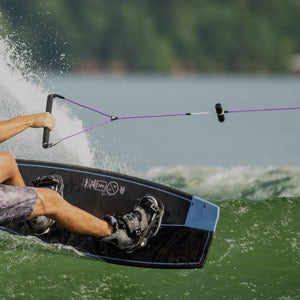
Wakeboard length is set by rider weight in centimetre bands. A rough guide: 20–39 kg riders need a 120–125 cm board; 40–50 kg riders sit at 125–130 cm; 51–65 kg riders at 130–135 cm; 66–80 kg riders at 135–140 cm; 81–95 kg riders at 140–145 cm; and 96 kg-plus riders need a board 145 cm or longer. Rider height can push the recommendation up one band but never down. Each brand publishes its own chart — the calculator above gives a brand-neutral starting point, then check the specific board's manufacturer chart for the final call.
No — boat wakeboards and cable wakeboards are different products and shouldn't be swapped. Boat boards have sharper edges, deeper channels, and lighter constructions designed for boat wakes and clean landings on water. Cable boards are built with reinforced bases, blunt edges, and a heavier construction to survive impacts with sliders, kickers, and obstacles at the cable park. Riding your boat board at the cable will damage the base and edges, and the damage isn't covered by warranty — manufacturers explicitly exclude park use for boat-spec boards. If you ride both, you need two boards.
Yes — but only as a one-way bump. Height can push the recommendation up one band when a rider is tall for their weight, because longer arms and a higher centre of gravity benefit from extra board length for stability. Height never pushes the recommendation down. A 175 cm 70 kg rider stays in the 135 cm band; a 195 cm 70 kg rider can step up to the 135–140 cm band. The calculator handles this automatically. Weight is doing the work; height is doing the adjustment.
Yes, with caveats. Pick the board sized for the heaviest regular rider in your group — lighter riders can ride a slightly larger board comfortably, but a heavier rider on an undersized board will struggle with starts and edge control. Open-toe bindings are essential for shared boards because they accept a range of foot sizes (typically a 3-size range per binding size). Closed-toe boots are sized like shoes and won't work across multiple riders. For families or boat crews where everyone rides, a 140 cm board with open-toe bindings is a common compromise.
Sign up to our mailing list so you don't miss out on exclusive deals, latest product drops and more.
Get the chance to Win Back your order!
Gifting has never been easier
Perfect if you're short on time or are unable to deliver your gift yourself. Enter your message and select when to send it.