









Gifting has never been easier
Perfect if you're short on time or are unable to deliver your gift yourself. Enter your message and select when to send it.
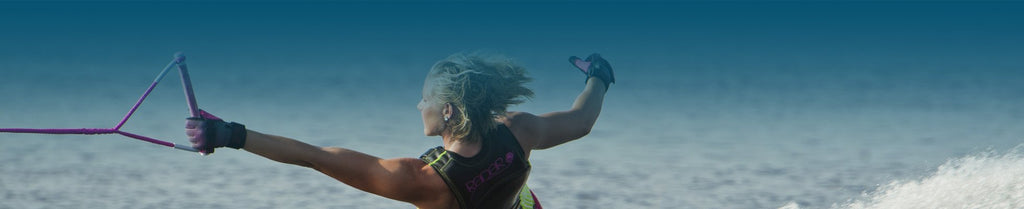
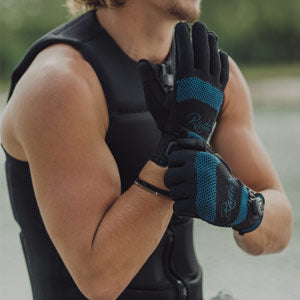
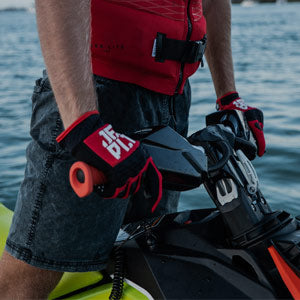
Slalom ski gloves for grip, blister prevention and less forearm fatigue — pre-curved fingers, Kevlar and Amara palms, BOA dial closures and half-finger options. From Radar, HO, Connelly, Masterline, Stealth and Pigoski.
Three reasons skiers wear gloves: holding on longer in high-load situations like the slalom course or jumping, preventing blisters and ripped calluses on regular sets, and reducing forearm fatigue across a long day. The right pair does all three; the wrong pair gives you cramps and doesn’t help. Match the glove to your handle. This matters more than most riders realise. Kevlar palm gloves grip hardest and are the right pair for high-aggression rubber handles — the kind you see on tournament slalom and jump setups. For EVA or stitched suede handles, a less aggressive palm material like Amara works better; a Kevlar palm on a softer handle is overkill and wears the handle out faster. The Stealth Kevlar and Pigoski Apex sit at the aggressive end; the Connelly Tournament, Radar Vapor and HO Syndicate range sit in the all-rounder middle; the Connelly Promo and Masterline Pro Team are the easy-going end. Pre-curved fingers. The single most important performance feature. Gloves with fingers pre-shaped into a natural grip position reduce the muscle effort needed to hold on — your hand isn’t fighting back to a flat position the whole set. Every serious slalom glove in the range is pre-curved. Closures: BOA vs strap. BOA dial closures (the click-wheel system on the Radar Airknit-K BOA, Vapor BOA-K and BOA-A, and Lyric-A BOA) give fast on-off and even tension across the wrist. Traditional Velcro wrist straps give finer adjustment but are slower. Both work — BOA is the modern preference for tournament riders. Full finger vs 3/4 finger. Full finger gloves are the standard — warmer, pre-curved properly, full coverage against the handle. 3/4 finger gloves expose the fingertips for dexterity and feel better in warm water. The Williams Tournament 3/4 Finger and HO World Cup 3/4 cover the half-finger options. Fit. Snug when dry, firm wrist strap or BOA dial. The smallest size you can comfortably get your hand into is usually the right one. A loose glove gives you cramps and doesn’t reduce fatigue. Gloves give a little once wet, so if it feels just right dry, it’ll be too loose in the water. Mens, womens and kids. Women’s cuts (Radar Lyric, Lyric-A BOA, HO Syndicate Angel, Connelly Womens Promo and Tournament, Williams Womens, Stealth Mingo, Pigoski Ultra Grip Pink Zebra, HO World Cup Womens) are shaped for narrower hands. The Radar TRA covers kids. Glove liners and palm protectors. The Masterline Kevlar Liners and Pigoski Ultra Liners sit underneath the outer glove for extra warmth or to extend the life of the outer glove on heavy use. The Masterline Palm Protector Sleeve is a separate alternative for riders who want grip and palm protection without the full glove. Brands. Radar runs the deepest range across BOA and standard closures. HO Syndicate, Connelly Tournament/Promo/Claw and Masterline USA cover the performance and tournament end. Stealth and Pigoski sit at the high-grip end. Williams covers 3/4 finger options.
Sign up to our mailing list so you don't miss out on exclusive deals, latest product drops and more.
Get the chance to Win Back your order!
