








Gifting has never been easier
Perfect if you're short on time or are unable to deliver your gift yourself. Enter your message and select when to send it.

Les on the theory behind kneeboard starts. Everything below follows the video.
The short answer. A kneeboard start is not a strength contest. The boat drags you along on top of the board like a toboggan until the board climbs out of the water and flattens — and that moment is your signal that there is finally enough support under you to pull yourself up. Everything else is about making that moment easy to reach and easy to read.
The three things that make the difference: a purpose-built hook handle, a gentle boat speed, and getting your knees into the right part of the board before you unhook.
This is the companion piece to the on-the-water run-through. If you just want the sequence of moves, that is the getting up on a kneeboard demo. This page is Les explaining why each part works, which is the bit that makes the demo stick.
Les covers the two deep-water starts here. The bank start gets named but not taught, so if that is the one you want, ask us rather than guessing at it.
Hooks are not new. They have been around for many years and come in a few different styles, but the principle is the same in all of them.
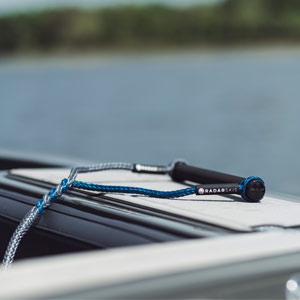
The part that matters is the handle. A purpose-built kneeboard handle has a small bar on it designed to connect to the hook. Because the bar is what sits in the hook, the actual grip the rider holds ends up much closer to their knees.
This is why hooking an ordinary handle is a worse option. Two things go wrong. It is much harder to get your fingers under it. And you have to lean a long way forward to reach the grip — particularly smaller kids, who end up out of position before the boat has even moved.
A proper kneeboard handle puts the grip close enough to your knees that your body position is right when you go to take it.
You lie on the board holding the handle, with the small bar hooked into the hook at the front. When the boat pulls, it pulls the board along, and you are merely being dragged along on top of it as if you are on a toboggan. Nothing is being asked of you yet.
Then the board climbs out of the water and starts to flatten. That is the change you are waiting for. Once it happens there is enough support underneath you to pull yourself up onto it.
Either is fine, and Les says it is totally up to you. What it comes down to is your grip strength and the amount of water running past you at the time.
Les is tall enough that he holds the front of the board instead. Some bicep action and he pulls himself up until his chest is over the top of the front part of the board, further forward than his elbows — he is not lying on the board anymore.
With his weight on his elbows, he can then draw his knees up onto the back of the board. From there, two options:
Get your knees right before you unhook. This is the critical part. Once your knees are in the correct part of the board, the board behaves and responds the way it was designed to. If you are too far back when you go to recover the handle, you are in a poor position to do it.
Knees where they belong, and you can readily grab the handle and take some load. Now you are kneeboarding.
Keep it low, down closer to your thighs or the crease in your waistline. That gives you the most control.
Leave the handle a long way out in front of you and it is much more difficult to have any control over your destiny. Turns get harder. Spins become near impossible.
Les is realistic about it: not everyone is strong enough to hold it there the whole time. The point to carry with you is that any time you want to move, the more strongly you can hold the handle low, the easier it is to rotate and sort out your direction.
It does not take much speed at all to bring a kneeboard up onto the plane. Even for a moderately sized adult, the speed is still quite gentle — slower than pulling a skier on double skis.
You do not have to guess when you are there, either. The board tells you:
Same theory, a little more work for you, because nothing is holding the handle for you.
Once the board climbs and settles flatter on the water, that is your signal that it is properly planing and it is time to get into your riding position.
Pull yourself forward onto the board so your weight is on your forearms. From there you can pull your knees up onto the board and work them forward.
At some stage you will run out of flexibility. Your knees will be close to the correct position but you will need to get upright to finish the job. If you can get your knees all the way forward, well done. If you are, as Les puts it, stiff as a board, you will get so far and then need to let go of the front of the board, get your body upright, and work your knees into the correct position from there.
Once you get there the board behaves, the handle comes in closer to your thighs rather than stretched out in front of you, and you are more stable with much easier directional control.
The hook sits on the front of the board. A purpose-built kneeboard handle has a small bar on it that connects to the hook, so the boat pulls the board along and you are dragged on top of it rather than having to hold your whole weight through the start. Once the board climbs out of the water and flattens, you pull yourself up onto it and then take the handle out of the hook.
It is a much worse option. It is harder to get your fingers under an ordinary handle, and you have to lean a long way forward to reach the grip, which puts you out of position before you start. That hits smaller kids hardest. A purpose-built kneeboard handle puts the grip much closer to your knees.
When it climbs out of the water and starts to flatten. The tell is the wall of water in front of the board dropping away and running gently out to the side. At that point there is less drag, you can see what is going on, and there is enough support under the board to take your weight.
Slowly. It does not take much speed to bring a kneeboard onto the plane, and even for a moderately sized adult it stays quite gentle - slower than pulling someone on double skis.
Either. It depends on your grip strength and how much water is running past you at the time. Les, being tall, holds the front of the board and uses his biceps to pull his chest up over the front of it.
Only after your knees are in the correct part of the board. Get that right first and the board behaves the way it was designed to. If you are still too far back when you go to recover the handle, you are in a poor position to do it.
Low, close to your thighs or the crease in your waistline. That gives you the most control. Held a long way out in front, turns get harder and spins become near impossible.
Usually because the board has not settled onto the plane yet. Once it flattens out, the water underneath is firmer, there is less drag and the board is noticeably more stable and less likely to roll.
Very common. Get your knees as far forward as you can with your weight on your forearms, then let go of the front of the board, bring your body upright, and work your knees into the correct position from there.
The on-the-water version of this lesson is how to get up on a kneeboard — the signals, the strap and the hand placement, start to finish. Setting a board up for a rider, including tow hooks and straps, is covered in how to set up your kneeboard, and the differences between board types are in the breakdown on kneeboards. Getting the rope onto the boat or ski is here, and vest fit is here. More lessons in the how-to guides.
If the handle is the thing letting you down, the kneeboard ropes and hook handles are the ones built with the bar. Tow hooks, straps and replacement parts are in kneeboard accessories, boards are in the kneeboard range, and everyone in the water needs a properly fitted life jacket.
Not sure whether your board takes a hook, or which handle fits it? Come into the shop at Moorooka in Brisbane, give us a call or send us an email — tell us what board you have and we will sort it out.
Presented by Les at Waterskiers World — Australia's dedicated towed water sports retailer, family-run for over 20 years from our Brisbane store and online. Talk to our team.
Sign up for exclusive deals, latest product drops and more, plus get a first-order discount.
