









Gifting has never been easier
Perfect if you're short on time or are unable to deliver your gift yourself. Enter your message and select when to send it.

Short answer: Getting up on two skis is about staying compact and letting the boat do the work. Practise the position on the bank first — sitting down, knees tighter than 90 degrees, heels near your backside, arms around the outside of your knees. In the water, keep only about 150 mm of ski above the surface. The driver applies throttle gently over a couple of seconds. When the skis flatten out and the pull on the rope suddenly gets lighter, that's your signal — stand up slowly, a quarter of the way at a time.
As Les puts it: the rope isn't there to hold you up. It's there to roll you into the right position so you can stand up under your own steam. That one idea fixes most first-timer starts.
The full session is below. The written version follows underneath.
Les runs a beginner through getting up on two skis, from bank drills to a deep-water start. 9 min 40 sec.
On the skis, look for bindings that open out nice and wide and also go quite small. That range matters for anyone who doesn't yet have the muscular control to hold their feet in exactly the right place — which is most first-timers.
The insert at the front of each ski is for a joining bar, which holds the two skis the correct distance apart. It's optional, but it takes one variable out of the start.
Don't go straight in the water. Get the skier sitting on the ground and build the position there — it's muscle memory before the boat is ever involved.
Sitting on the ground, feet out in front:
Hand them the handle in that position.
Take the rope and apply a small amount of pressure. You're not trying to drag them along the ground — just load the rope.
Now the important part: the skier relaxes their arms. No pulling. When they relax, their shoulders and chest come towards their knees, which is exactly what you want. A little more pressure and their backside slides towards their heels.
Watch for feedback. If you feel them pulling on the handle, tell them to relax. Relax, relax. Let the boat pull you.
Keep adding pressure. The chest presses towards the knees, the backside lifts off the ground, and they end up in a squat with their weight flat on their feet.
Hold it. Don't stand up. Give it five seconds and just get used to being balanced down there.
Slowly rise a quarter of the way. Then halfway. Then back down. Then up again.
This is teaching muscular control. The temptation is to say "yes, you've got it, stand up" — but any fast action gets a fast result, and a fast result is usually a random one. Slow it down and use the legs.
Run through the whole bank drill a couple of times before anyone gets wet.
Decide whether you're using the joining bar. If you are, join the skis together before they go in the water.
Have the bindings adjusted fully out to their largest setting when you hand the skis over. The skier can close them up once their foot is in — either they'll manage it or you can help. Adjusting them to size first sounds sensible, but depending on the foot it can be quite hard to get in.
Once they're in the water with both skis on, pass them the handle.
If you're throwing it, throw it well past them so they can grab the rope and pull it in. Try to avoid throwing the handle at their head.
Take the rope and pull them along with a bit of tension, and see if they can get the skis into the right position. Do that a couple of times to get them steady before you hook up to the boat and go anywhere.
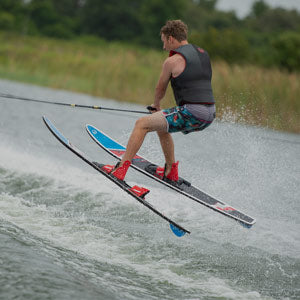
What you're looking for: both skis parallel, the same distance apart, and only about 150 mm of ski out of the water.
This is the one most beginners get wrong. Water skis generate lift by being in the water. Lift the tips a long way out and you've got much less ski working for you — the feet go high, the body goes low, water washes over the top of the skier, and the whole thing becomes a struggle. Keep the skis low.
Before the boat moves:
That rope check is the last thing you do before you get moving.
Put the boat in gear to take up tension. Let the skier settle — the skis should be fairly steady, not waving left and right or up and down. When you're happy with how they're sitting, apply gentle and progressive throttle.
You're not taking off from a green light. You're not trying to rip the handle out of their hands. Bring the speed up over a couple of seconds, not one.
Most beginners end up planing somewhere between 10 and 15 to 20 km/h depending on their weight — but Les is blunt about this: you don't actually know what that number is for this skier on this day. You just keep increasing until it happens.
The skier's head should stay clearly visible. If it disappears under a wall of water, they're leaning too far back.
If they stand up very quickly and go straight out the front, that's not a strength problem — go back and reinforce the position. Stay small, stay low, move slow.
As speed builds, the skier feels pressure increase as the water pushes against the skis. That water is doing the work of lifting their body mass out, and it only happens once a certain speed is reached.
Then the skis lift the person up and flatten out on top of the water, and the pull on the rope drops away. It gets noticeably lighter.
That's the signal. Stand gently and progressively to about a quarter height. After a couple of seconds, stand a little taller. The observer can help by pointing or waving to get their attention — stand up, stand up.
Then pause. Smile. Couple of selfies and away you go.
Roughly 30 cm, a bit more or less depending on your height and leg length. There's no hard and fast rule — people often just say shoulder width. What matters more is that the knees stay together, which the arms-around-the-outside grip takes care of.
About 150 mm. Skis generate lift by being in the water, so tips held high just means less ski helping you up.
Enough to get the skier planing, which is usually somewhere between 10 and 15 to 20 km/h depending on their weight. There's no fixed number — keep increasing progressively over a couple of seconds until the skis come up.
When the skis flatten onto the surface and the pull on the rope drops away. That lighter feeling is the signal. Stand a quarter of the way, pause, then keep rising over the next few seconds.
No, but it helps. It holds the two skis the correct distance apart, which removes one thing the beginner has to manage during the start. Fit it before the skis go in the water.
Hand the skis over with the bindings fully open, and close them up once the foot is in. Sizing them first can make them quite hard to get into, depending on the foot.
No. The rope isn't there to hold you up — it rolls you into the correct position so your legs can stand you up under your own steam.
About this guide. Written from the Learning with Les video demonstration by Les Walters, and produced by Waterskiers World — Australia's dedicated towed water sports retailer, family-run for over 20 years from our Brisbane store and online. Not sure what setup suits the rider's age and ability? Talk to our team — we ride this gear.
Sign up for exclusive deals, latest product drops and more, plus get a first-order discount.
